
Bible Translations
Compare 14 Bible Translations Side by Side
Every translation makes interpretive choices. Seeing those choices next to each other reveals meaning that any single version hides. Verse Scholar gives you instant side-by-side comparison across 14 trusted English translations.
Why Comparing Translations Matters
No English translation can perfectly capture every nuance of the Hebrew and Greek originals. Formal equivalence translations like the KJV, ASV, and NASB prioritize word-for-word accuracy, preserving the grammatical structure of the source text even when it produces unusual English phrasing. Dynamic equivalence translations like the NLT prioritize conveying the original thought in natural modern English, sometimes restructuring sentences entirely.
Neither approach is wrong — they serve different purposes. A pastor preparing an expository sermon might lean on the NASB for its precision. A small group leader might choose the NLT for its clarity with new readers. A scholar comparing how translators handle a difficult Greek participle needs both, plus several more options.
When you read Romans 3:25 in the KJV, you encounter the word “propitiation.” The BSB renders it “atoning sacrifice.” The NLT says “sacrifice for sin.” Each captures a different facet of the Greek hilasterion. Seeing all three together gives you a richer understanding than any one alone, and that is exactly what Verse Scholar's translation comparison provides for every verse in the Bible.
Available Translations
Formal equivalence
The most widely printed English Bible in history. Its Elizabethan prose set the standard for biblical English and remains the preferred translation for many congregations.
Balanced
A modern translation that balances literal accuracy with readability. Free and open-licensed, making it ideal for digital study platforms.
Formal equivalence
A public domain translation based on the ASV, updated with modern English while preserving formal accuracy.
Formal equivalence
Known for its extreme literalness and consistent word-for-word rendering of Hebrew and Greek terms.
Formal equivalence
Regarded by many scholars as the most literally accurate modern English translation, frequently used in academic settings.
Dynamic equivalence
A thought-for-thought translation that prioritizes natural English readability while maintaining theological precision.
Balanced
Distinguished by its extensive translator notes — over 60,000 — explaining the reasoning behind every major translation decision.
Plus seven additional translations including the Douay-Rheims, Young's Literal Translation, Webster's Bible, and more — covering the full spectrum from ultra-literal to highly readable, from 16th-century to 21st-century scholarship.
How Side-by-Side Comparison Works
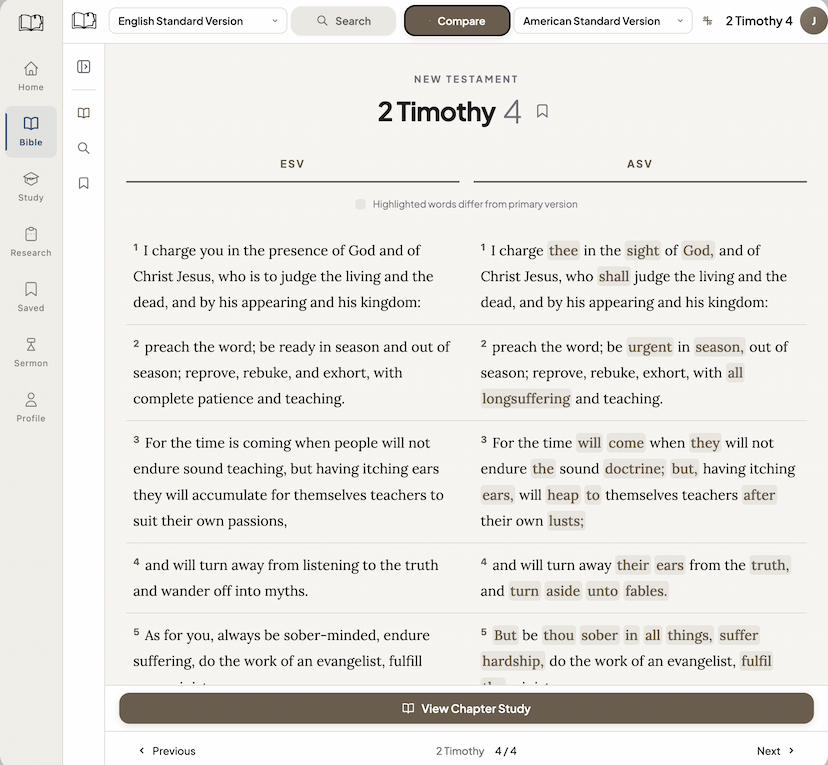
Navigate to any verse in Verse Scholar and the translation panel displays your selected versions aligned by verse number. Differences between translations are immediately visible, letting you spot where translators diverge on tense, voice, word choice, or sentence structure.
Pair translation comparison with the word study tool to drill into why a particular word differs across versions. When the KJV says “charity” and the BSB says “love” in 1 Corinthians 13, the word study reveals that both translate the same Greek word — agape — but from different eras of English usage.
You can also use translation comparison alongside cross-references to see how the same Hebrew or Greek term is translated differently in different Old and New Testament contexts, revealing patterns of meaning that deepen your study.
See Every Translation, Every Verse
Start comparing translations for free. Create an account and open any passage to see 14 versions side by side.